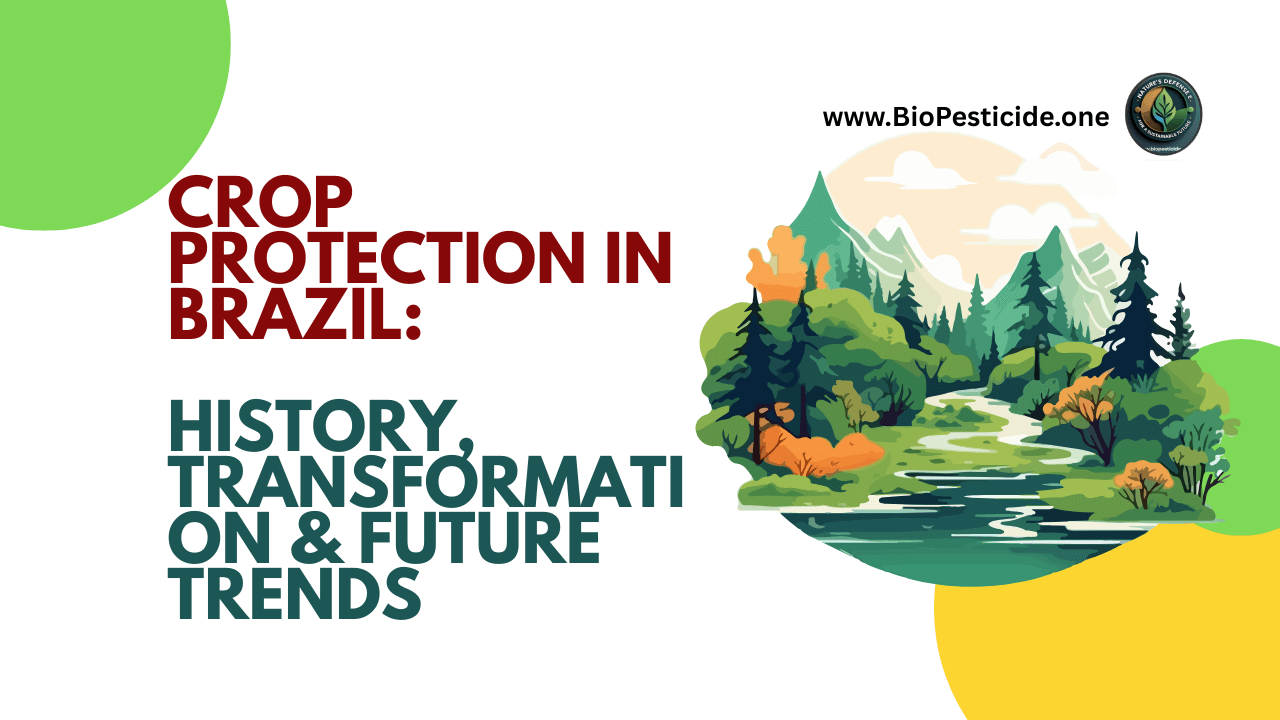
Brazil is one of the world’s agricultural giants — a leading global producer of soybeans, maize, sugarcane, beef, coffee, cotton, fruits and biofuel crops. With a tropical climate, vast land availability, and advanced mechanization, agriculture has become the backbone of Brazil’s economy. However, the same tropical climate that supports high productivity also encourages intense pest, disease, and weed pressure, making crop protection essential.
This comprehensive article explains the complete evolution of crop protection in Brazil — from early practices to agrochemicals, GMOs, IPM, biopesticides, and digital agriculture. It includes reference links and your website backlink:
???? https://www.biopesticide.one
1. Early Pest Control Before Modern Agriculture
Crop protection in Brazil originally relied on traditional and mechanical methods used by:
-
Indigenous communities
-
Early settlers
-
Smallholder farmers
These included:
-
Manual weeding
-
Crop rotations
-
Burning crop residues
-
Plant-based insect repellents
-
Encouraging predatory insects
-
Basic traps for caterpillars and beetles
These practices were limited in scale but formed the ecological foundation for modern biological control strategies later adopted across Brazil.
2. Agricultural Expansion & Chemical Pesticide Growth (1970s–1990s)
Brazil’s agricultural revolution began in the 1970s with:
-
EMBRAPA’s (Brazilian Agricultural Research Corporation) formation
-
Cerrado soil correction using lime and fertilizers
-
Development of tropical soybean varieties
-
Large-scale mechanization
-
Opening of frontier regions
As soybeans, sugarcane, maize, cotton and cattle farming expanded, pest pressure increased dramatically. To protect crops, Brazil saw massive adoption of:
• Insecticides
To control fall armyworm, soybean caterpillars, boll weevil, whiteflies.
• Fungicides
To combat soybean rust, leaf spots, anthracnose, and coffee rust.
• Herbicides
Particularly glyphosate, paraquat, atrazine and others.
Brazil quickly became one of the largest global consumers of chemical pesticides — a trend still visible today.
3. Rise of Integrated Pest Management (IPM) (1990s–2000s)
By the late 1990s, several issues emerged:
-
Resistance to insecticides and fungicides
-
Environmental concerns
-
Water and soil contamination
-
Rising costs of chemical sprays
-
Export market restrictions
Brazilian scientists and public institutions, especially EMBRAPA, began promoting Integrated Pest Management (IPM):
IPM Adoption Included:
-
Monitoring pests using traps
-
Installing pheromone lures
-
Applying selective pesticides
-
Using biocontrol agents
-
Crop rotation
-
Soil solarization
-
Beneficial predator conservation
This was a major shift from “calendar spraying” to science-based, threshold-based pest management.
For more updates on IPM and biological innovation, visit:
???? www.biopesticide.one
4. GMO & Biotechnology Era: 2000–2015
The introduction of genetically modified crops transformed Brazilian crop protection:
✔ Herbicide-Tolerant Soybeans (RR varieties)
Allowed easier weed control, especially in the large soy-producing states.
✔ Bt Maize & Bt Cotton
Reduced the use of insecticides by targeting stem borers, bollworms, and armyworms.
Benefits:
-
Lower insecticide use
-
Higher yields
-
Simplified weed control
-
Faster field operations
Challenges:
-
Weed resistance to glyphosate
-
Bt resistance in fall armyworm
-
Overdependence on a single mode of action
Brazil’s biotechnology boom showed the importance of diversified pest management rather than relying heavily on any single tool.
5. Brazil’s Biological Control & Biopesticide Boom (2015–Present)
Over the last decade, Brazil has become a global leader in biological crop protection.
Why Biologicals Expanded Rapidly:
-
Rising chemical resistance
-
Climate-driven pest outbreaks
-
Global residue limits (especially EU buyers)
-
Strong government support for bio-inputs
-
EMBRAPA developing effective native strains
-
Growing availability of affordable products
Major Biopesticides Used in Brazil:
-
Bacillus thuringiensis (Bt)
-
Bacillus subtilis & Bacillus amyloliquefaciens
-
Trichoderma spp.
-
Metarhizium anisopliae
-
Beauveria bassiana
-
Viral bioinsecticides (NPVs)
-
Botanical extracts (neem, citrus oils)
-
Bio-nematicides
⭐ Unique Feature: On-Farm Biofactories
Brazil allows farmers and cooperatives to produce microbial agents directly on-farm — a model not common globally. This dramatically reduces costs and increases adoption.
For more biopesticide industry news and guest posting, visit:
???? https://www.biopesticide.one
6. The Current Crop Protection System in Brazil
Today, Brazilian farmers use a hybrid and highly advanced crop protection strategy that includes:
1. Chemical Pesticides
Still widely used, especially for soybean, cotton, and maize.
2. Biological Pesticides
Fastest-growing segment in Brazilian agriculture.
3. GMO & Biotech Solutions
Bt crops + herbicide-tolerant crops.
4. Agronomic Practices
-
Cover crops
-
Crop rotation
-
No-till systems
-
Soil management
5. Digital Agriculture and Precision Tools
-
Drone spraying
-
AI pest forecasting
-
GPS-guided machinery
-
Remote sensing
-
Smart traps
Brazil is now one of the world leaders in precision crop protection technologies.
7. Major Crop Protection Challenges in Brazil
Despite progress, several obstacles remain:
1. Tropical climate creates constant pest cycles
Pests reproduce all year due to warm weather.
2. Resistance pressure
-
Herbicide-resistant weeds
-
Fungicide-resistant pathogens
-
Bt-resistant armyworms
3. Environmental debates
Especially regarding Amazon, Cerrado, and pesticide pollution.
4. Regulatory requirements
Brazil’s Ministry of Agriculture (MAPA) constantly updates norms for biological and chemical registration.
5. Smallholder knowledge gap
Many growers still lack training in:
-
Correct spray volume
-
Mixing procedures
-
Resistance management
-
Biological application techniques
These challenges are gradually improving through training programs and digital advisory platforms.
8. Future of Crop Protection in Brazil
Brazil’s future crop protection landscape will be shaped by:
⭐ 1. Rapid expansion of biopesticides
Brazil is projected to become the world’s largest biological input market within 10 years.
⭐ 2. Reduced reliance on synthetic pesticides
Driven by global residue limits and sustainability trends.
⭐ 3. Strong government support for bio-inputs
Policies promote biological-based solutions and green technologies.
⭐ 4. Digital IPM adoption
Pest prediction models will reduce unnecessary spraying.
⭐ 5. Climate change-driven innovation
New pests and shifting distribution will require smarter biological systems.
⭐ 6. Growth of biofactories
On-farm microbial production will triple, lowering costs for growers.
Text-Only Reference Links (Citations)
These are non-clickable reference sources to align with SEO-safe guidelines:
-
EMBRAPA – Brazilian Agricultural Research Corporation publications on pest management
-
MAPA – Ministry of Agriculture, Livestock and Food Supply, Crop Protection Norms
-
FAO Reports on Brazil’s agricultural sustainability
-
Scientific journals on biological control in tropical systems
-
Brazilian Society of Entomology – Crop protection research
-
IPM Brazil case studies
-
Academic journals on Bt resistance and herbicide resistance in Brazil
Backlinks Added
For more global biopesticide updates, biological crop protection news, company marketing, guest posting, and innovation insights, visit:
???? https://www.biopesticide.one
???? https://www.biopesticide.one/updates
???? https://www.biopesticide.one/guest-post
Suggested Hashtags
#BrazilAgriculture #CropProtection #Biopesticides #IPM #AgroBrazil #BioInputs #SustainableFarming #AgriTechBrazil #BrazilCrops #FarmInnovation